How do you know whether a used hydraulic pump should be remanufactured or recycled? And could data help make this decision before the pump is opened?
The FREIMAN consortium visited Masino-Konaflex in Turku on 8 October 2026 to see how hydraulic pumps are inspected, remanufactured and tested in practice. Later, a business workshop followed at Jokicenter. The visit brought together 20 participants from all FREIMAN project partners.
Visiting Masino-Konaflex remanufacturing workshop
Masino-Konaflex remanufactures and services hydraulic pumps and manufactures hydraulic power units for applications such as the marine sector. The company also has extensive facilities for testing and adjusting hydraulic pumps.
During the factory tour, FREIMAN participants saw different pump models, hydraulic power units, assembly operations and testing facilities.A particularly interesting part of the visit was seeing how experienced employees assess wear in hydraulic pump components.
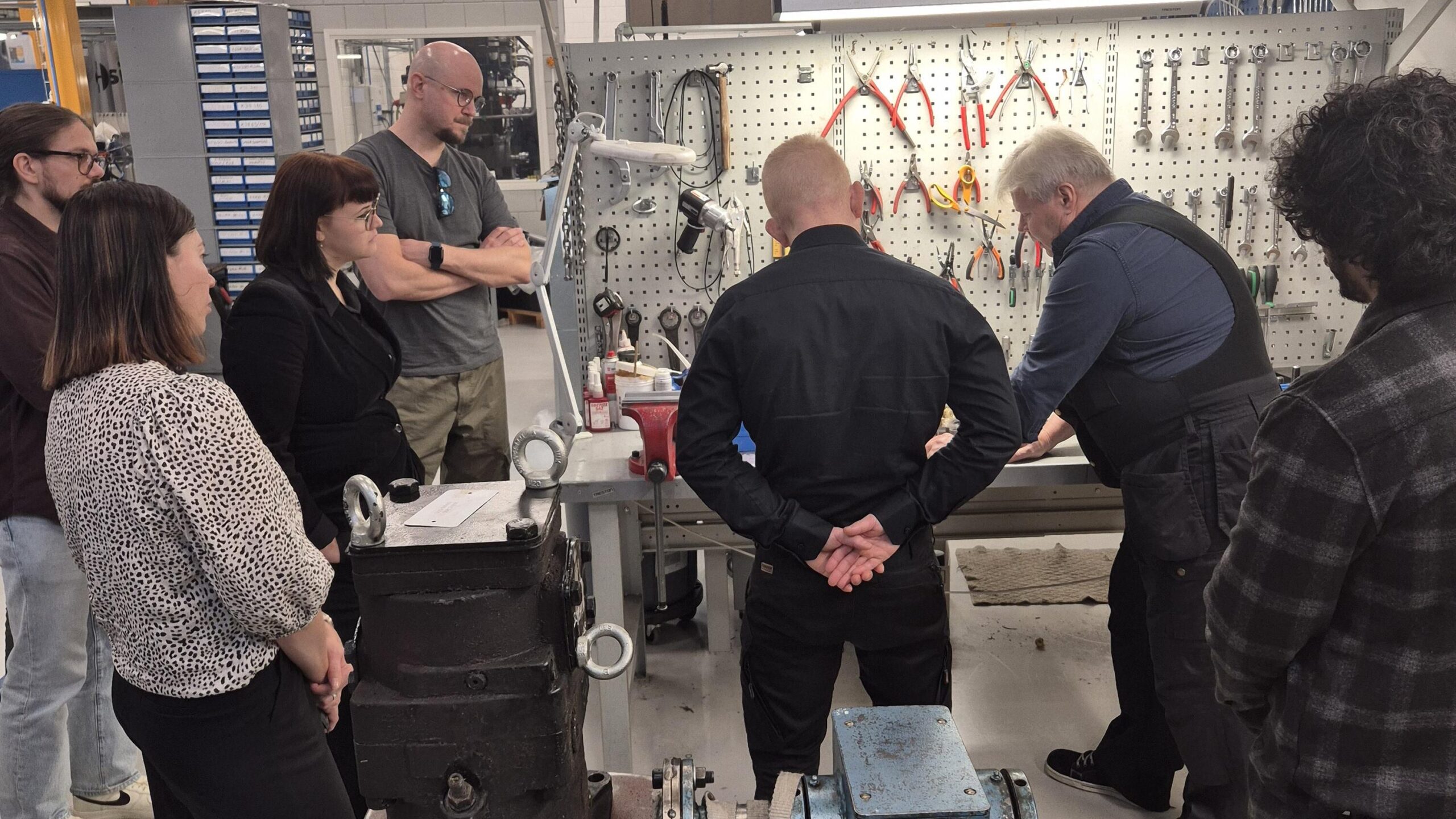
FREIMAN consortium participants learning how typical wear in hydraulic pump components is assessed at Masino-Konaflex.
Even very small amounts of wear can matter. Tolerances in critical components are tight, and wear of only hundredths of a millimetre can significantly affect pump efficiency.
Some components are also expensive to replace. If a critical high-value component such as swash plate is too worn, remanufacturing the entire pump may no longer be economically feasible. However, some of its remaining value may still be recovered by using suitable components as spare parts for other pumps.
Valuable knowledge is still in people’s heads, not with AI
Assessing a used pump is not simply a matter of measuring components.
Experienced employees have accumulated knowledge over careers spanning several decades. They recognise typical wear patterns in different pump models and understand how applications and operating conditions affect the pumps.
Even the oil provides important clues. An unusual smell, metallic particles or the use of an unsuitable oil can indicate potential problems and help an experienced employee focus the inspection on the right components.
Can we know the condition before opening the pump?
One of the fundamental challenges of remanufacturing is the uncertain condition of returned components, or cores.
The actual condition of a hydraulic pump may only become clear after it has been cleaned, opened and inspected. By this point, time and resources have already been spent.
Could some of this uncertainty be reduced before the pump is opened?
Traceability creates the foundation
Masino-Konaflex and Ponsse have already taken an important step towards data-driven remanufacturing within the FREIMAN project.
Their processes and IT systems have been developed to improve the traceability of hydraulic pumps between the companies. Information about the forest machine from which a pump originates can now be connected with information produced during the remanufacturing process.
Data has been accumulating during the project. During 2027, the amount of data is expected to become sufficient for exploring AI-based analysis.
Sustainable remanufacturing needs data from many sources
The visit strengthened one of the central hypotheses of the FREIMAN project: no single data source provides enough information for optimal remanufacturing decisions.
Better decisions may require combining several types of data based on traceability:
- Machine data: serial numbers (machine, core parts such as pumps and engines), use hours, machine sensor measurements, alarms and components data e.g. load, tyre pressure/temperature
- Environmental data: weather, temperature and traversability
- Maintenance data: scheduled maintenances, repairs and warranty operations
- Remanufacturing data: inspection results, remanufacturability, statistical information on processed pump types and volumes, spare-part prices and availability, and tacit knowledge
- End-user data: productivity, load and machine utilisation
Together, these data sources can provide a much richer understanding of the condition, history and remaining value of a product or component.
Connecting information across manufacturers, machine users, service providers and remanufacturers can help reduce uncertainty, improve productivity and preserve more product value over multiple lifecycles.
This is a key step towards data-driven and scalable remanufacturing ecosystems where the joint data creates value for everyone.
What information is needed for better business decisions?
After the factory visit, the consortium continued the day at Visitor and Innovation Centre Joki.
The workshop focused on a simple question: What are remanufacturing decisions that need data driven knowledge, why it is difficult today and what information is needed to make them better?
Researchers and company representatives worked together on three industrial cases:
- deciding pricing of deposits and core paybacks
- deciding when a hydraulic pump is till recoverable as remanufactured or when it should be recycled
- identifying factors affecting contractor decisions affecting core part, tyre condition and lifetime
The findings from the workshop and FREIMAN’s business research will be discussed in future blogs.