
Rising material costs, increasing sustainability requirements and growing demand for circular economy solutions are transforming remanufacturing from a niche aftermarket activity into a major industrial growth business. According to the FREIMAN market study, lifecycle data, AI and access to returned components are becoming critical competitive assets for companies seeking to capture value from this transformation. These developments are particularly relevant for Finnish industries such as forestry, mining and mobile work machinery.
Download the free market report!
Key takeaways
- Remanufacturing is rapidly becoming a major industrial growth market
- Product lifecycle data is emerging as a key competitive asset enabling Re-X strategies
- Future remanufacturing business relies on design-for-remanufacturing, AI, data and lifecycle native business models
Over 100 Meur business opportunity
Remanufacturing is evolving from a secondary service activity into a strategic industrial capability. The global remanufacturing market already exceeds 100 billion USD and has clear growth in many application areas, especially in automotive sector. Growth is driven by the need to reduce material consumption, improve resource efficiency and comply with increasingly demanding sustainability targets.
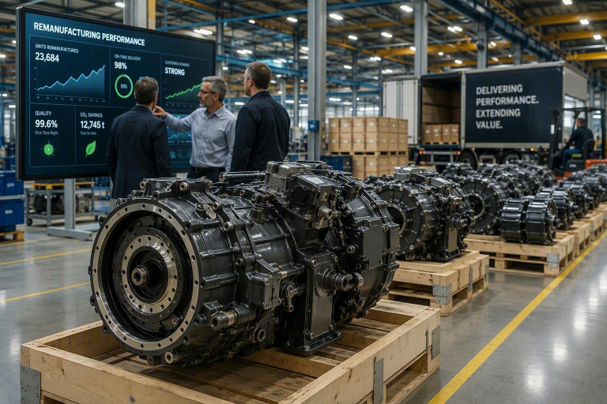
For Finland, the opportunity is especially significant in sectors where products have long operational lifetimes, high-value components and established service networks. Industries such as forestry machinery, mining equipment and off-highway machinery already possess many of the characteristics that support profitable remanufacturing business models.
Automotive remanufacturing market is estimated to be around USD 80 billion in 2025, rising to approximately USD 185 billion by 2034 [6]. Non-road mobile machinery is also a significant related market, estimated at around USD 66,2 billion in 2025 and approximately USD 95 billion by 2035 [7]. The forestry equipment market is smaller in absolute terms, but still strategically relevant, in the range of USD 9 – 12 billion in 2025 and USD 11 – 15 billion by 2031 depending on provider and market framing [8], [9], [10]. [References from the report]
Data is Becoming as Valuable as the Physical Product
One of the strongest findings of the FREIMAN study is that future competitiveness will depend not only on manufacturing expertise, but increasingly on lifecycle data, condition information and traceability. Companies that understand how, where and under what conditions products have been used can make better decisions about maintenance, reuse, remanufacturing and recycling.
In the future, data may become as valuable as the physical component itself. Maintenance records, operating conditions and product history help reduce uncertainty and improve remanufacturing decisions throughout the product lifecycle.
Access to Returned Components Will Define Market Leaders
Reliable access to returned components, often referred to as “cores”, is becoming one of the most important factors in scaling remanufacturing. Without predictable return flows, even highly capable remanufacturing operations struggle to grow.
Leading OEMs are already strengthening their reverse logistics capabilities, installed-base visibility and return channels to secure future remanufacturing capacity. Companies such as Caterpillar, John Deere, Komatsu, Volvo and Ponsse increasingly integrate remanufacturing into their broader lifecycle and service strategies. Their approaches combine dealer networks, return incentives, quality assurance processes and digital lifecycle management systems.
Technology Outlook: From Repair to Intelligent Lifecycle Management
FREIMAN report list technologies that can help companies determine whether a component should be reused, repaired, remanufactured or recycled, ultimately maximising lifecycle value while reducing environmental impact.
0-2 years
2-5 years
5-10 years
- Enablers: AI-assisted inspection, condition monitoring, and predictive maintenance
- Barriers: Variable core condition and limited data availability
- Enablers: Increased technological maturity, digital twins, and traceability (e.g. DPP)
- Barriers: Increasing electronics and software complexity limiting remanufacturing
- Enablers: Design-for-remanufacturing, lifecycle-native business models and integration of software-enabled components
- Barriers: Dependence on proprietary software and restricted data access
In the near term, AI-assisted inspection, predictive maintenance and condition monitoring can improve the assessment of returned components and reduce uncertainty in repair decisions. Their impact, however, depends on the availability and quality of lifecycle data.
Over the next few years, digital twins, traceability solutions and Digital Product Passports are likely to support more scalable remanufacturing. By linking product identity, operating history and material information, these tools can guide decisions on reuse, repair, remanufacturing and recycling.
In the longer term, products will need to be designed for disassembly, diagnostics, component recovery and lifecycle extension. For Finnish companies, this creates an opportunity to combine strong engineering capabilities with advanced digital services.
Report references
[6] Fortune Business Insights, ‘Automotive Remanufacturing Market Size, Share, & Industry Analysis’. Accessed: Jun. 22, 2026. [Online]. Available: https://www.fortunebusinessinsights.com/automotive-remanufacturing-market-107428
[7] WiseGuyReports, ‘Global Non-Road Mobile Machinery (NRMM) Market Research Report’, Apr. 2026, Accessed: Jun. 22, 2026. [Online]. Available: https://www.wiseguyreports.com/reports/non-road-mobile-machinery-nrmm-market
[8] ‘Forestry Equipment Market Size, Share, Growth, and Industry Analysis’. Accessed: May 22, 2026. [Online]. Available: https://www.marketreportsworld.com/market-reports/forestry-equipment-market-14719947
[9] ‘Forestry Machinery Market Size & Share Analysis – Growth Trends and Forecast (2026 – 2031)’, Mordor Intelligence. Accessed: Jun. 22, 2026. [Online]. Available: https://www.mordorintelligence.com/industry-reports/forestry-machinery-market
[10] ‘Forestry Equipment Market Trends and Future Opportunities Report [2032]’. Accessed: May 22, 2026. [Online]. Available: https://www.congruencemarketinsights.com/report/forestry-equipment-market